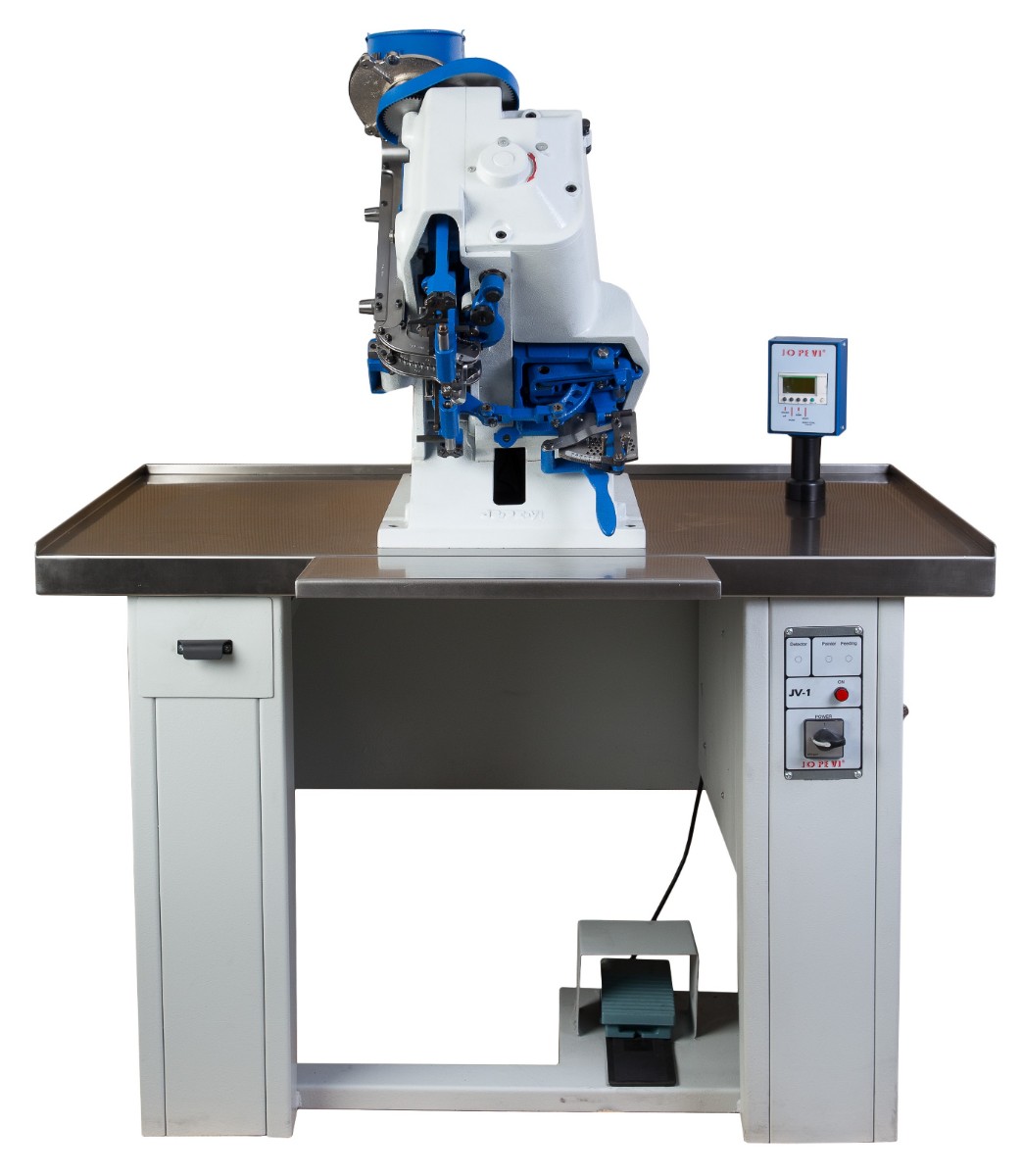
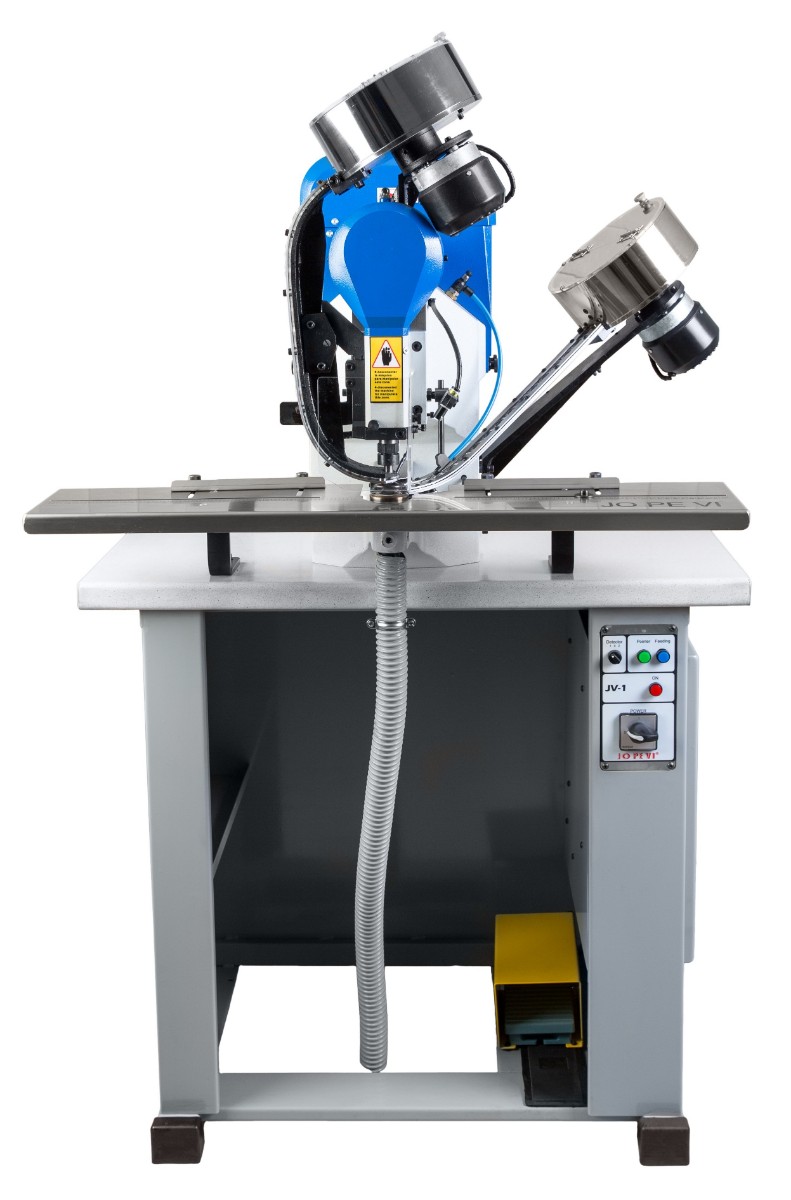
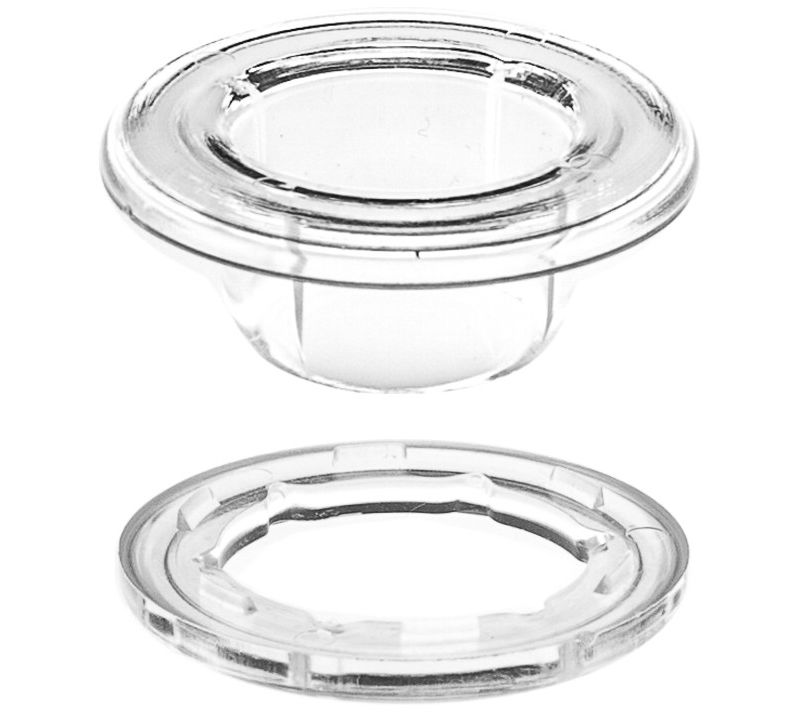
Micro-ergonomics at the eyelets workstation: repetitive motions, heights, lighting, noise…
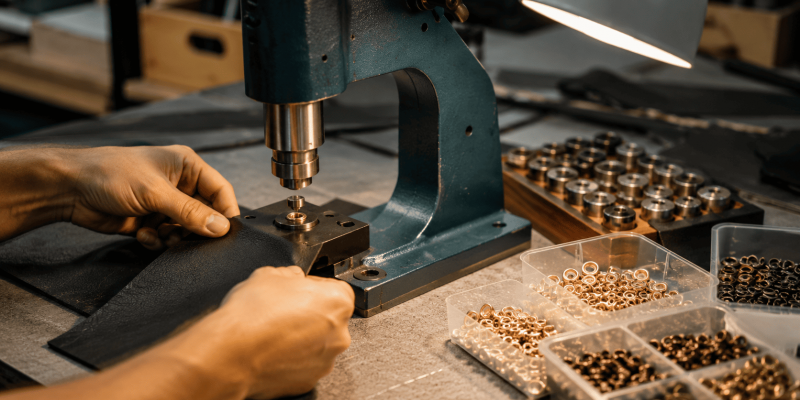
In eyelets processes, many improvements do not come from a radical change, but from small, well-thought-out adjustments. In footwear, leather goods, garment making, curtains, awnings, tarpaulins or digital printing, the difference between a smooth day and a heavy one often lies in how the workstation is organised.
That is, in essence, micro-ergonomics. It is about repeated gestures, the distance to a washer, how light falls on the work point, or whether the pedal forces the leg more than it should. It seems minor, but in day-to-day production it makes a big difference.
When a part is picked up, positioned, the equipment is actuated and then removed hundreds of times, any unnecessary twist ends up taking its toll. More finishing errors also appear, from poorly presented parts to deformations or off-centre placements that force rework.
- Common materials at these workstations, such as textiles, tarpaulins, plastic, PVC or cardboard.
- Real applications in garment, footwear, leather goods, curtain and digital printing workshops.
- Benefits of good organisation, with better visual accuracy, fewer wasted movements and a better operating rhythm.
The interesting thing is that you can almost always start by observing the workstation with fresh eyes. Sometimes, the problem is not the operator, but a poorly solved detail around the machine.
When eyelets come out better, there is almost always a better thought-out workstation
In eyelets setting, the real order of the work matters far more than it seems. If the piece comes in from one side, the consumable is far away and the exit forces you to twist your torso, the cycle becomes slower and less precise. What should you review first? Usually, the path of the hands and the pedal position.
A well-planned table, accessible containers and a clear surface help each gesture make sense. It is also worth reviewing the lighting over the setting point, because seeing the component position clearly helps spot defects earlier, reduce shadows and avoid annoying reflections.
Noise and vibrations also say a lot. If the equipment sounds different or transmits abnormal behaviour, it is usually a good idea to check settings, wear or pending maintenance. That protects comfort, yes, but also the consistency of the finish.
- Place materials in the order of use, to avoid reaching and crossing hands.
- Adjust the seat, table and pedal, according to the person and the type of piece.
- Alternate postures and short breaks, in high-repetition tasks.
- Check light and shadows, especially in fine-detail areas.
And there is another useful, very workshop-style question: how many movements do you repeat every hour without any real need? That is where the most worthwhile improvements usually appear.
Our experience with eyelets starts in the workshop and ends at a more fine-tuned workstation
From the very beginning, at JOPEVI we understood that good production does not depend only on the mechanism. We have more than 55 years of experience and we manufacture our own machinery to set eyelets, rivets and fastening systems in sectors where every workstation detail influences the final result.
We work from Elche Parque Empresarial and support workshops that need to adapt their processes to very different materials, paces and formats. If you want to better understand our track record as a machinery manufacturer since 1969, you will see why we pay so much attention to how the workstation is used in real life.
We do not stop at choosing the model. We also assess installation, access, type of piece, nearby lighting, working method and operator needs so that the machine truly fits the production process.
If you produce with eyelets and want a more comfortable, precise and productive process, we can guide you towards the most suitable solution based on your materials, the type of component and your workshop’s daily pace.
- Office: C/ Nicolas De Bussi, 32 (Elche Parque Empresarial), Elche, Alicante
- Phone numbers: +34 966 65 10 08
- Email: info@jopevi.es