Recording incidents in the grommet machinery area and finding patterns: a way to make your production more effective
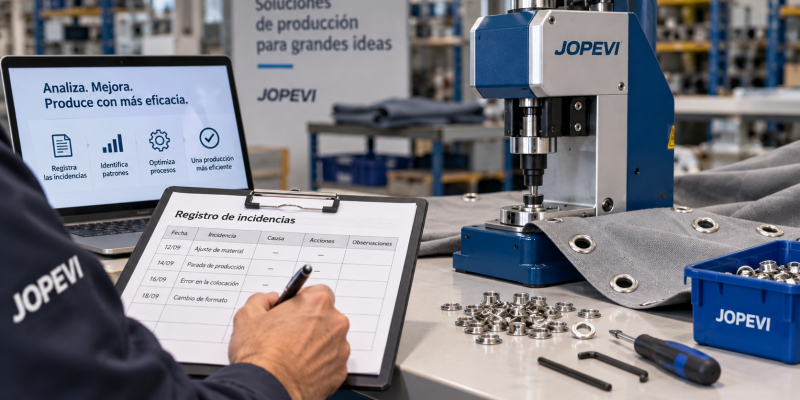
With grommet machinery, many day-to-day incidents can seem isolated until you start recording them with a clear method and discover that behind every stoppage there is usually a sequence. What matters is not only solving the immediate problem, but understanding when it repeats, in what context it appears and what decisions it allows you to make so production can move forward with greater continuity.
In many workshops and production lines, interruptions are accepted as a normal part of the process. However, when they are noted down in a simple and consistent way, they stop being a vague nuisance and become operational information. That is where the shift in perspective happens, because a well-recorded incident does not end when the solution is found; it opens the door to detecting patterns that previously went unnoticed.
This is especially useful when working with different materials, references or production rhythms, because not every situation affects the equipment’s behaviour in the same way. A one-off adjustment, incorrect placement, an unexpected pause or a stoppage due to a job change may seem minor, but over time they help draw a much clearer picture of the real process.
That is why recording does not mean filling in endless reports or making work more bureaucratic. It means capturing everyday signals before they are lost, so they can be reviewed later from a more strategic perspective and turn production experience into a tool for improvement.
What grommet machinery reveals when you stop putting out fires and start reading patterns
Grommet machinery provides much more information than it may seem at first glance, especially when the team records incidents with a certain level of discipline. It does not need to be complicated, because in many cases it is enough to note what happened, when it happened, which material was being worked on and what action was needed to resume production.
That small history makes it possible to answer very useful questions. For example, whether certain interruptions always appear at the start of a shift, whether some adjustments are repeated after reference changes, or whether specific placement errors arise more often when the work pace is accelerated. The key is not an isolated incident, but repetition, because that is where the pattern begins to appear.
Imagine a common situation in any production environment. For several days, brief stoppages related to readjustments after changing material are recorded. Each one, on its own, seems manageable. But when the log is reviewed, the team discovers that those pauses are always concentrated in the same type of order and at a specific stage of the process. That reading already makes it possible to act more effectively, whether by reviewing prior preparation, improving the changeover sequence or fine-tuning the way that reference is handled.
The opposite can also happen: an apparently significant incident may not occur again and therefore should not influence broader decisions. Recording helps both to detect recurring problems and to avoid overreacting to one-off events, which is especially valuable when time, resources and maintenance need to be prioritised.
Another important point is that the log gives structure to internal conversations. When production, maintenance and line managers work with recorded facts, it is easier to understand what really happened, not just what people remember. That difference may seem small, but it greatly changes the quality of decisions. Instead of relying on impressions, the team begins to base its work on an observable sequence.
From this perspective, noting down incidents is not an accessory task, but a way to gain a better understanding of the process itself. And if you are considering adding new equipment or reviewing the way you work, it may be useful to consult the JOPEVI solutions catalogue to understand which options best fit your production environment and the type of work you do.
How we at JOPEVI understand the real value of grommet machinery in production
At JOPEVI, we know that grommet machinery is not valued only for what it does when everything is running smoothly, but also for how it integrates into the real production routine, where there are material changes, adjustments, pauses and decisions that must be made quickly. That is why we talk about incidents not simply as a technical problem, but as a source of learning about the process.
Our history, which began in 1969 and has developed from Elche alongside sectors such as footwear, leather goods and garment manufacturing, has allowed us to identify one constant. The most organised environments are not those that never have incidents, but those that know how to interpret them. When a company records what happens and reviews that information regularly, it gains the ability to anticipate situations, organise time more effectively and reduce improvisation.
This practical approach fits especially well in processes where every interruption has a cumulative impact. If a stoppage forces part of the work to be redone, if an adjustment is always repeated under certain conditions, or if a placement error appears during specific batch changes, the important thing is not only to solve it quickly. What is truly useful is understanding the logic behind that repetition so the next shift can start with greater clarity.
We recommend observing the process with one simple question in mind. Not only what happened, but what that repetition is telling you about the way you produce. Sometimes the answer points to maintenance, sometimes to prior preparation, sometimes to work organisation and, in other cases, simply to the need to standardise certain steps that each operator currently resolves differently.
In the end, working this way turns the incident history into a management tool. It is no longer just about reacting, but about building a more predictable and better-prepared process. And that is one of the reasons why grommet machinery that is well integrated into everyday work can deliver much more than one-off performance, because it also helps create more stable and better-understood production.
- Phone: +34 966 65 10 08
- Email: info@jopevi.es
- Address: C/ Nicolás De Bussi, 32 (Elche Parque Empresarial), Elche, Alicante, España