Mass customisation: how to organise the grommets area for short runs and highly varied models
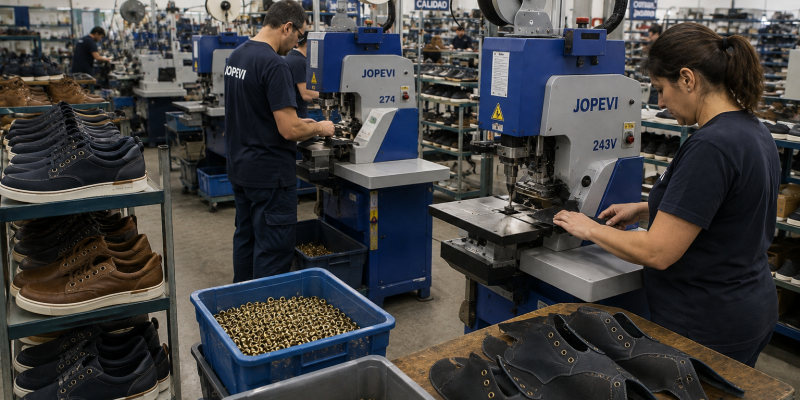
When a footwear factory runs many models, colours and materials at once, grommets stop being a minor detail. They become a sensitive point in the process. If that area is not properly planned, every reference change triggers searching, waiting and small interruptions that end up weighing more than it seems.
In short runs, the issue is not usually only about fitting components. It is about how the workstation is prepared, how parts arrive, and how the switch from one model to another is handled without breaking the pace. That is where good organisation makes the difference.
The most practical approach is to see this area as a part connected to the rest of production, not as an isolated table at the end of the line. Keeping tools, consumables and already-identified parts nearby prevents unnecessary movement. It also reduces mistakes when the operator switches tasks several times in the same day.
On a day-to-day basis, these guidelines tend to work well:
- Clear space to handle uppers and parts without awkward crossovers.
- Trays or boxes per model with components already separated.
- Tooling visible and accessible depending on the type of work planned.
- A clear in/out sequence so the station does not get overloaded.
When this logic is truly applied, production breathes better. And in footwear, you notice it straight away.
If you work with varied models, grommet setting requires a truly flexible workstation
There is a very common question in workshops with high rotation: is it better to prepare each change on the fly, or to have it fully set before starting? In our experience, grommet setting works best when each small batch reaches the station with its components checked, pairs counted, and the work order already decided.
That calls for machinery that can adapt to different references without making the operation more complex. Not every manufacturer needs the same type of solution. That is why it makes sense to assess whether your production fits better with manual, pneumatic or automatic options, always according to the type of shoe, the real volume and the changeover frequency.
In an area designed for short series, it often helps a lot to have:
- Versatility in use to alternate different jobs without setting up a new system every time.
- Comfortable access to consumables and accessories throughout the day.
- A simple method to pre-kit references before they enter the station.
- A layout that makes handovers between operators or tasks easier.
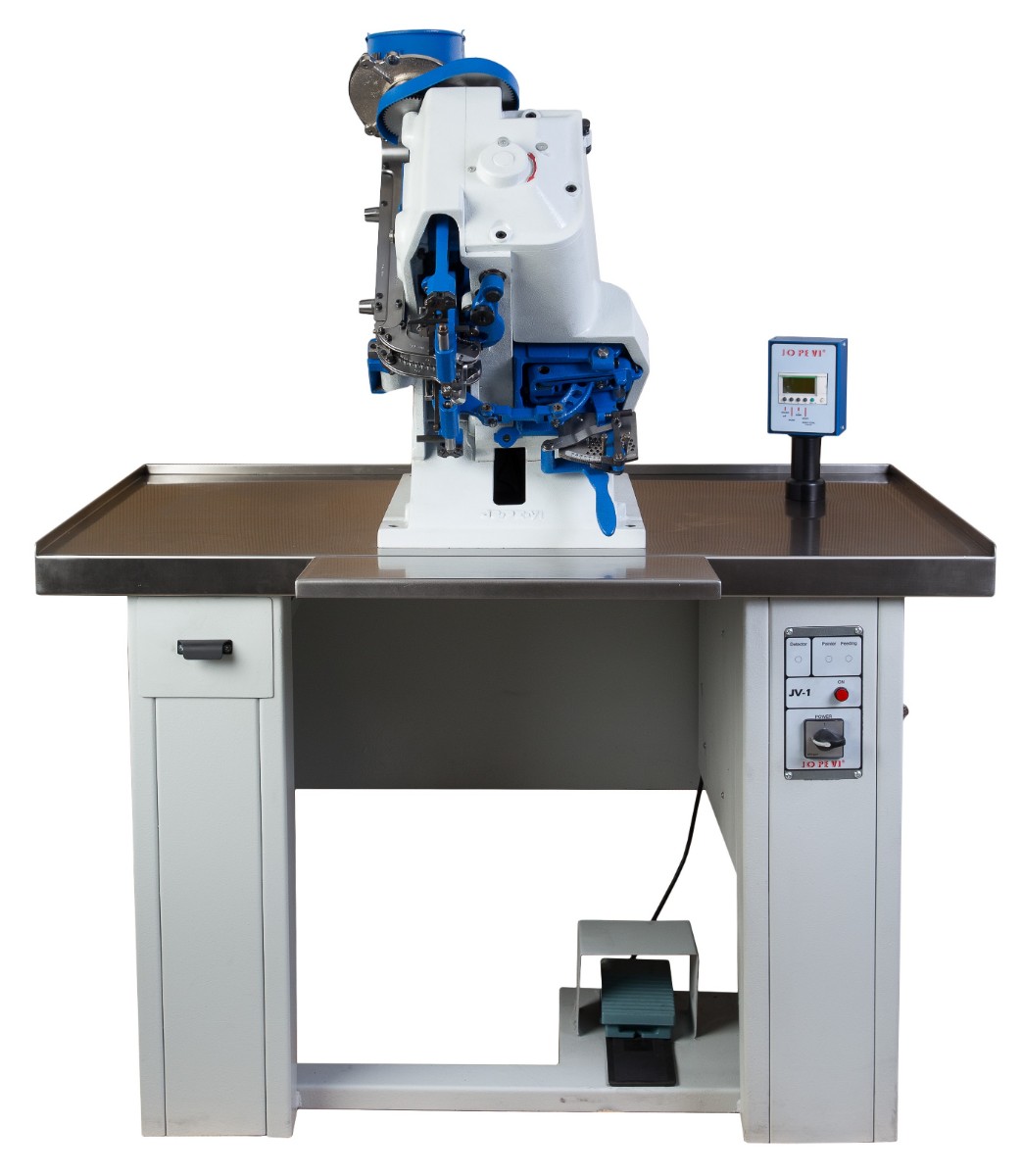
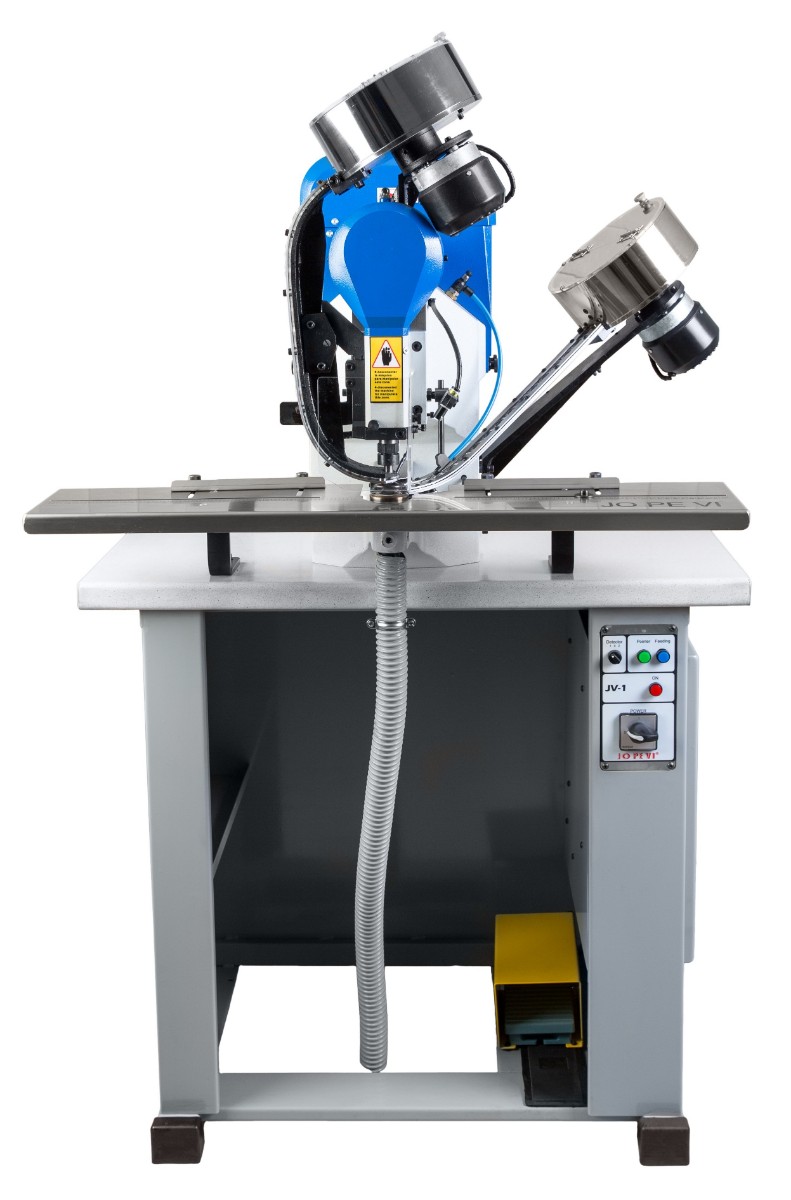
Models such as J-21, J-25 or J-22, as well as automatic solutions like J-237 Plastico or J-239 Plastico, address different needs within that changing scenario. The key is not to choose out of habit, but based on the real work that comes out each week.
With grommets properly planned, we help you choose without complicating your production
After many years close to footwear and leather goods, we know that every workshop has its own way of working. grommets are not handled the same way on a stable line as in production with continuous changes. That is why we listen first to how you manufacture, and then we guide the choice.
Our company has evolved from a repair workshop into a manufacturer with our own design and in-house production. We operate from Elche Parque Empresarial, very close to the footwear industrial environment, and that proximity helps us understand real shop-floor issues better. If you want to explore the full catalogue of eyelet setting systems, you can see different solutions there depending on how you produce.
We rely on a range designed for sectors such as footwear, garment making and leather goods, with experience in materials such as textile, cardboard, canvas, plastic and PVC. In addition, we offer international distribution and a close, personal service that remains one of our hallmarks.
If you are reviewing how to improve your grommets area, we can help you assess which option best fits your model changes, your space and your production pace.
- Office: C/ Nicolas De Bussi, 32 (Elche Parque Empresarial), Elche, Alicante
- Phones: +34 966 65 10 08
- Email: info@jopevi.es